Definition of a Data Warehouse
A Data Warehouse (DWH) is a centralized, enterprise-wide repository of integrated data collected from multiple, disparate operational and external sources. It is specifically designed and optimized for querying, reporting, and data analysis, rather than for running daily transaction processing systems.
Key Characteristics
According to data management pioneer W.H. Inmon, a data warehouse is defined by four foundational characteristics:
-> Subject-Oriented: Unlike operational systems designed to support specific business processes (like order entry), a data warehouse is organized around major subjects of the enterprise—such as Customers, Products, Sales, or Suppliers—focusing on modeling and analyzing business operations rather than running them.
-> Integrated: Data is gathered from multiple heterogeneous sources (relational databases, flat files, cloud apps, APIs) and reconciled into a consistent format. This involves resolving naming conflicts, standardizing units of measure, encoding schemes, and cleansing inconsistent data.
-> Non-Volatile: Data in a warehouse is read-only and stable. Once loaded, operational updates (deletions, modifications) do not affect it. New data is simply added as a new increment, preserving a permanent historical record.
-> Time-Variant: A data warehouse maintains historical data spanning a long time horizon (typically 3 to 10 years or more), allowing analysts to study trends, shifts, and patterns over time (e.g., comparing sales this quarter against the exact same quarter five years ago).
Role of a Data Warehouse in an Enterprise
The data warehouse serves as the single source of truth (SSOT) for business intelligence and data-driven decision-making. Its primary roles include:
-> Separation of Workloads: Offloads complex, resource-intensive analytical queries away from primary transactional databases (OLTP systems), preventing performance degradation on mission-critical applications.
-> Consolidated Business View: Bridges data silos across different departments (HR, Sales, Finance, Marketing) to provide a unified corporate dashboard.
-> Data Cleansing and Quality Control: Acts as a validation layer where inconsistent data from various sources is standardized before business users act upon it.
-> Foundation for BI & Advanced Analytics: Powers executive dashboards, visual reporting tools (e.g., Tableau, Power BI), data mining, and machine learning models.
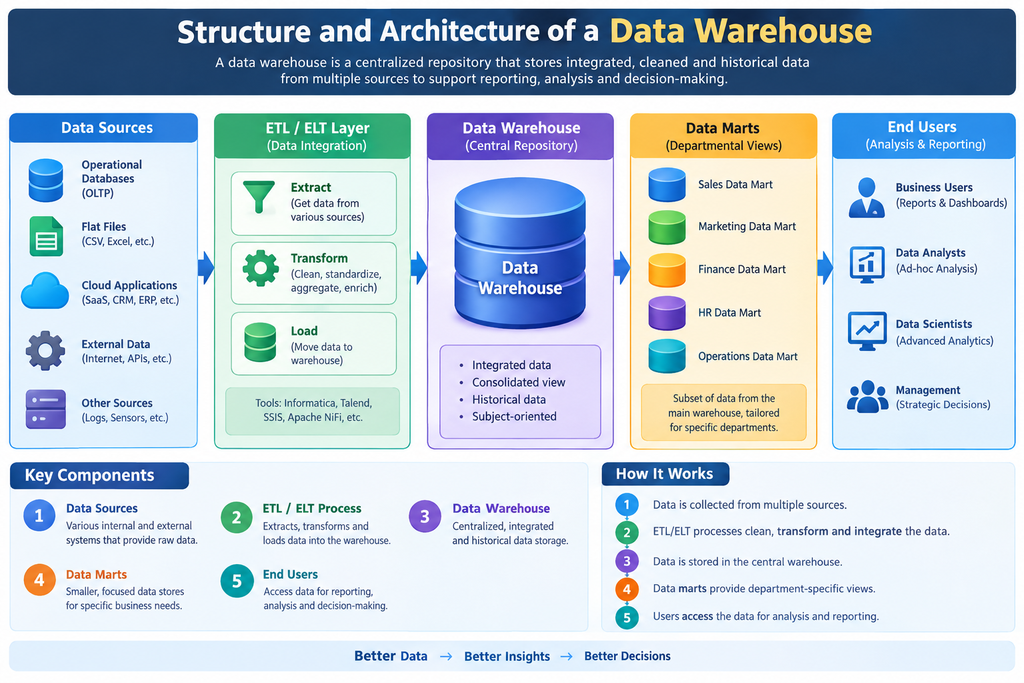
Structure and Architecture of a Data Warehouse