Team management in Software Project Management (SPM) is the art of coordinating diverse technical talents to achieve a unified goal. Unlike hardware engineering, software development is highly abstract and depends heavily on human communication and logic, making the “people” aspect the most critical factor in a project’s success.
1. Team Structures
The way a team is organized significantly impacts how information flows and how decisions are made.
- Democratic Decentralized (DD): No permanent leader. Decisions are made by group consensus. This works well for high-level research or complex problem-solving where creativity is paramount.
- Controlled Decentralized (CD): A defined leader coordinates sub-teams. This is the most common structure in large-scale software firms, where a Project Manager oversees several “squads” or “modules.”
- Controlled Centralized (CC): Top-down decision-making. A senior manager or architect makes all major technical and strategic choices. This is efficient for routine, well-defined tasks but can stifle innovation.
2. The Stages of Team Development (Tuckman’s Model)
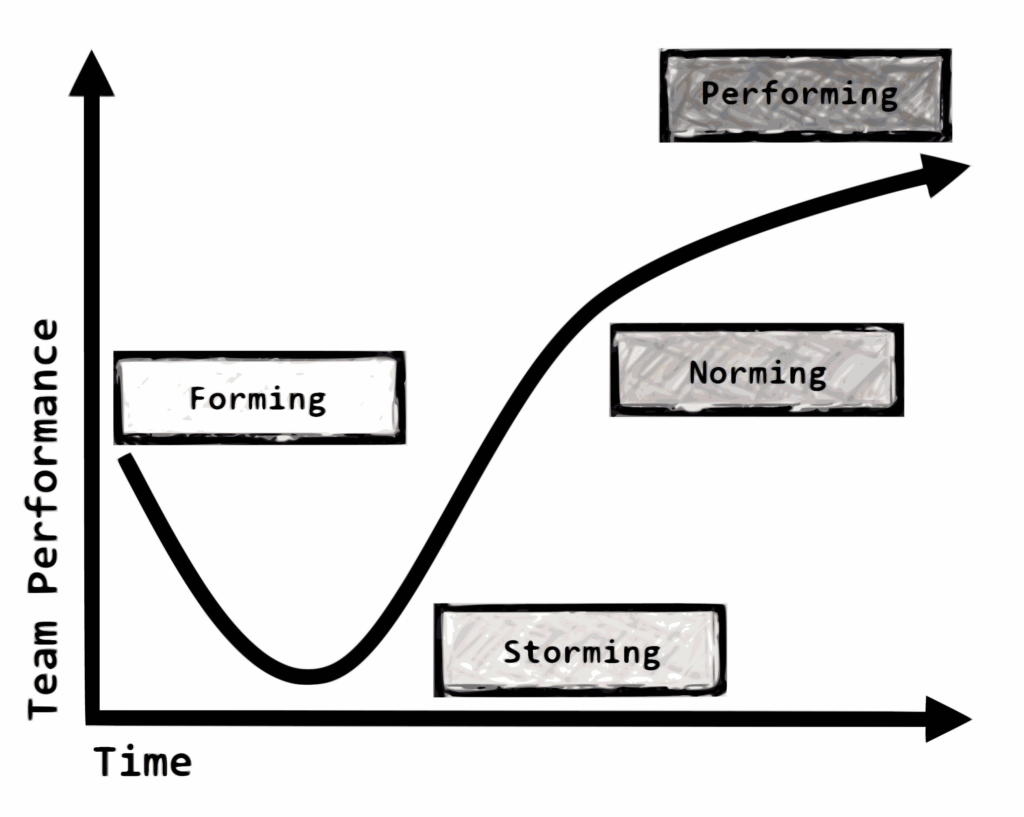
A project manager must recognize that teams do not start at peak performance. They go through a predictable lifecycle:
- Forming: Members are polite but guarded. Roles are unclear.
- Storming: Conflict arises as personalities clash and technical opinions differ.
- Norming: The team establishes “ground rules” and starts working together.
- Performing: The team is functional, high-energy, and focuses on the project goal.
- Adjourning: The project ends, and the team disbands.
3. Key Management Responsibilities
Motivation and Morale
Software development can be mentally exhausting. Managers use various models, such as Maslow’s Hierarchy of Needs, to ensure team members feel secure, valued, and intellectually challenged. Providing “autonomy, mastery, and purpose” is often more effective than financial incentives alone in tech environments.
Conflict Resolution
In SPM, conflicts usually arise from technical disagreements (e.g., which framework to use) or resource competition. Effective managers use techniques like:
- Collaboration: Finding a “win-win” solution.
- Compromise: Both parties give up something.
- Smoothing: De-emphasizing the disagreement to maintain harmony (temporary fix).
Communication Management
According to Brooks’ Law, “adding manpower to a late software project makes it later” because the communication overhead increases exponentially. A manager’s job is to minimize “noise” and ensure that developers have the documentation and specifications they need without being overwhelmed by unnecessary meetings.
4. Software Team Roles
A balanced team typically includes a mix of specialized roles to ensure all project dimensions are covered:
| Role | Responsibility |
| Project Manager | Budget, schedule, and stakeholder communication. |
| Software Architect | High-level technical design and system integrity. |
| Developers | Writing, refactoring, and unit-testing code. |
| QA/Testers | Identifying bugs and verifying requirements. |
| Product Owner | Representing the user’s needs and prioritizing features. |
5. Performance Monitoring
Managing a team also requires tracking how well they work together. Common metrics include:
- Team Velocity: How much work the group completes per iteration.
- Turnover Rate: Tracking if team members are leaving frequently, which might indicate culture issues.
- Peer Reviews: Using “360-degree feedback” to assess collaboration and technical contribution.