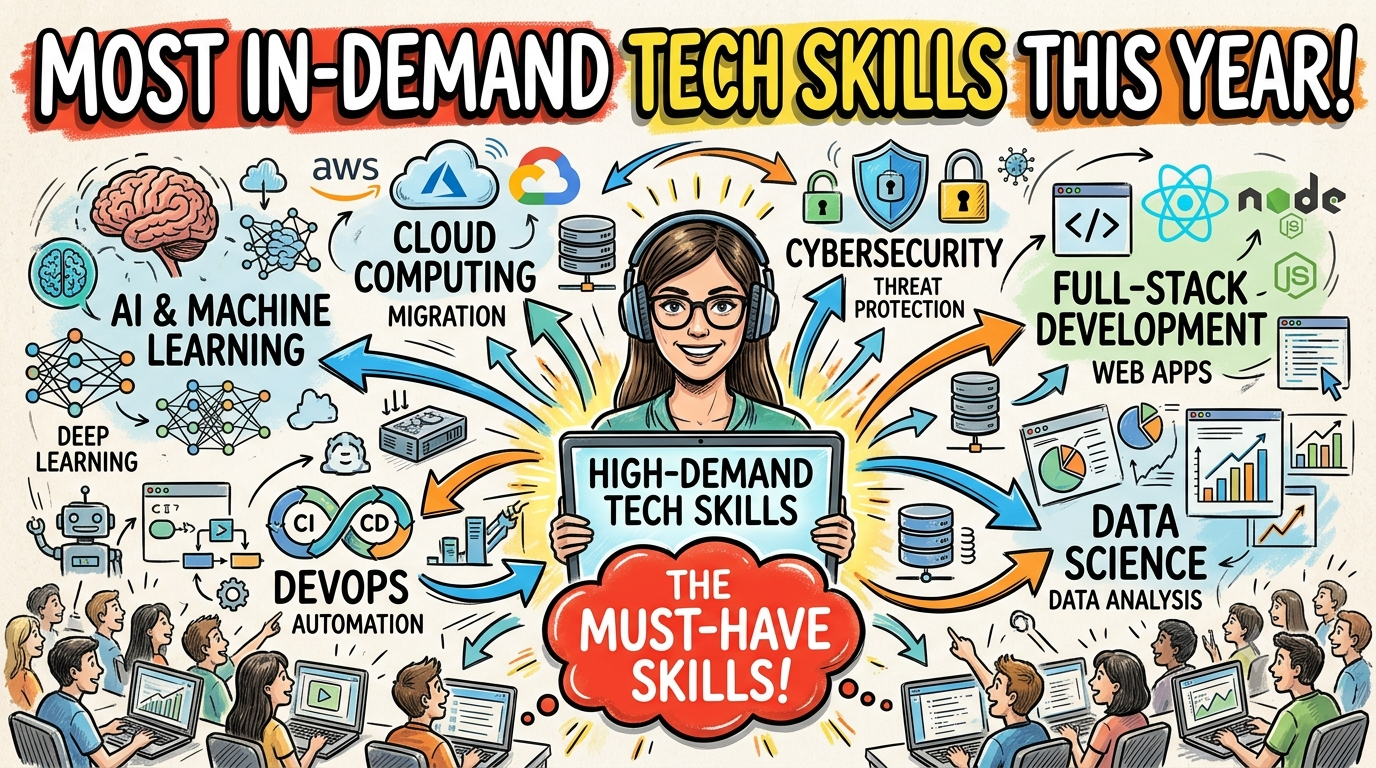
Technology is changing faster than ever, and companies are constantly searching for professionals with the right skills. Whether you’re a student, recent graduate, or working professional looking to switch careers, learning the right tech skills can open the door to better job opportunities and higher salaries.
The good news is that you don’t need a computer science degree to start learning many of these skills. With online courses, hands-on practice, and dedication, anyone can build a strong foundation in today’s most in-demand technologies.
In this article, we’ll explore the top tech skills companies are looking for this year and why they matter.
1. Artificial Intelligence (AI)
Artificial Intelligence is one of the fastest-growing areas in technology. Businesses are using AI to automate tasks, improve customer experiences, analyze data, and make better decisions.
AI powers tools like chatbots, virtual assistants, recommendation systems, and image recognition software.
Why Companies Need AI Skills
Companies want employees who can:
- Build AI-powered applications
- Automate repetitive tasks
- Improve business efficiency
- Analyze large amounts of data
Popular AI Tools
- ChatGPT
- Google Gemini
- Microsoft Copilot
- TensorFlow
- PyTorch
Even learning how to use AI tools effectively can make you more valuable in almost any job.
2. Data Analysis and Data Science
Businesses collect huge amounts of information every day. However, raw data is useless unless someone can analyze it and turn it into meaningful insights.
Data analysts help companies understand customer behavior, improve products, and increase profits.
Important Skills
- Microsoft Excel
- SQL
- Python
- Power BI
- Tableau
- Statistics
Almost every industry now depends on data-driven decision-making.
3. Cybersecurity
As cyberattacks become more common, companies are investing heavily in protecting their systems and customer information.
Cybersecurity professionals help prevent hacking, data breaches, and online fraud.
Important Areas
- Network security
- Ethical hacking
- Cloud security
- Security monitoring
- Risk assessment
- Digital forensics
Cybersecurity remains one of the most stable and high-paying career paths.
4. Cloud Computing
Many companies no longer store their applications on physical servers. Instead, they use cloud platforms to reduce costs and improve flexibility.
Cloud computing skills are now required for many IT jobs.
Popular Platforms
- Amazon Web Services (AWS)
- Microsoft Azure
- Google Cloud Platform (GCP)
Cloud professionals help businesses deploy applications, manage infrastructure, and improve system reliability.
5. Software Development
Software developers continue to be in high demand across industries.
Companies need developers to build websites, mobile applications, business software, and cloud services.
Popular Programming Languages
- Python
- JavaScript
- Java
- C#
- Go
- TypeScript
Learning programming also improves problem-solving skills and logical thinking.
6. Web Development
Every business needs a professional website.
Web developers create websites that are fast, secure, and user-friendly.
Front-End Skills
- HTML
- CSS
- JavaScript
- React
- Angular
- Vue.js
Back-End Skills
- Node.js
- PHP
- Python
- Django
- Laravel
- Express.js
Full-stack developers who understand both front-end and back-end technologies are especially valuable.
7. Mobile App Development
Smartphones have become a major part of daily life, increasing the demand for mobile applications.
Businesses want developers who can build apps for Android and iOS.
Popular Technologies
- Flutter
- React Native
- Kotlin
- Swift
Cross-platform development skills are especially popular because they reduce development costs.
8. DevOps
DevOps combines software development with IT operations to improve software delivery.
Companies using DevOps release updates faster while maintaining system stability.
Important Tools
- Docker
- Kubernetes
- Jenkins
- Git
- GitHub Actions
- Terraform
DevOps engineers are among the highest-paid professionals in the technology industry.
9. Machine Learning
Machine learning is a branch of AI where computers learn from data instead of following fixed instructions.
It is used in:
- Fraud detection
- Recommendation systems
- Medical diagnosis
- Stock market analysis
- Image recognition
Skills Needed
- Python
- Mathematics
- Statistics
- TensorFlow
- Scikit-learn
Machine learning engineers continue to be in strong demand worldwide.
10. UI/UX Design
A product’s success depends not only on how it works but also on how easy it is to use.
UI (User Interface) designers create attractive layouts, while UX (User Experience) designers focus on making products simple and enjoyable.
Popular Design Tools
- Figma
- Adobe XD
- Sketch
Companies value designers who understand both creativity and user behavior.
11. Digital Marketing
As businesses move online, digital marketing has become one of the most valuable skills.
Companies need professionals who can attract customers through online channels.
Important Areas
- Search Engine Optimization (SEO)
- Content Marketing
- Social Media Marketing
- Email Marketing
- Google Ads
- Analytics
Digital marketing combines creativity with data analysis to grow businesses.
12. Blockchain
Although blockchain is best known for cryptocurrencies, businesses also use it for secure transactions, digital identity, and supply chain management.
Companies working in finance and technology continue to hire blockchain developers.
Skills
- Solidity
- Ethereum
- Smart Contracts
- Web3 Development
13. Internet of Things (IoT)
The Internet of Things connects everyday devices to the internet.
Examples include:
- Smart homes
- Smart watches
- Smart factories
- Connected vehicles
IoT engineers work with sensors, hardware, cloud computing, and software development.
14. SQL and Database Management
Almost every application stores information inside databases.
Understanding how databases work is valuable for developers, analysts, and IT professionals.
Popular Databases
- MySQL
- PostgreSQL
- MongoDB
- Microsoft SQL Server
SQL remains one of the most requested technical skills in job listings.
15. Soft Skills Matter Too
Technical knowledge alone isn’t enough.
Companies also look for candidates who have strong professional skills.
Important soft skills include:
- Communication
- Teamwork
- Problem-solving
- Critical thinking
- Time management
- Adaptability
- Leadership
- Creativity
Employees who combine technical expertise with excellent communication often progress faster in their careers.
How to Learn These Skills
You don’t need to learn everything at once. Instead, choose one area that matches your interests and career goals.
Here are a few tips to get started:
- Take online courses from trusted platforms.
- Build personal projects to practice your skills.
- Create a portfolio showcasing your work.
- Contribute to open-source projects.
- Earn industry-recognized certifications.
- Stay updated with the latest technology trends.
- Join online communities and attend webinars.
Consistency is more important than trying to learn everything quickly.
Which Skill Should Beginners Learn First?
If you’re just starting your tech journey, these are excellent beginner-friendly options:
- Python for programming and automation
- HTML, CSS, and JavaScript for web development
- SQL for database management
- Excel and Power BI for data analysis
- Cloud fundamentals (AWS, Azure, or GCP) to understand modern infrastructure
- AI tools like ChatGPT and Microsoft Copilot to boost productivity
Once you’ve mastered the basics, you can move into specialized fields such as AI, cybersecurity, cloud computing, or mobile app development.
Final Thoughts
Technology continues to reshape every industry, making digital skills more valuable than ever. Companies are no longer looking only for people with degrees—they want individuals who can solve real-world problems using modern tools and technologies.
Whether your goal is to become a software developer, data analyst, cybersecurity expert, cloud engineer, or digital marketer, investing time in learning relevant tech skills can significantly improve your career prospects.
The best approach is to start with one skill, practice consistently, build real projects, and keep learning as technology evolves. In a rapidly changing job market, continuous learning is the key to staying competitive and opening the door to exciting opportunities.