
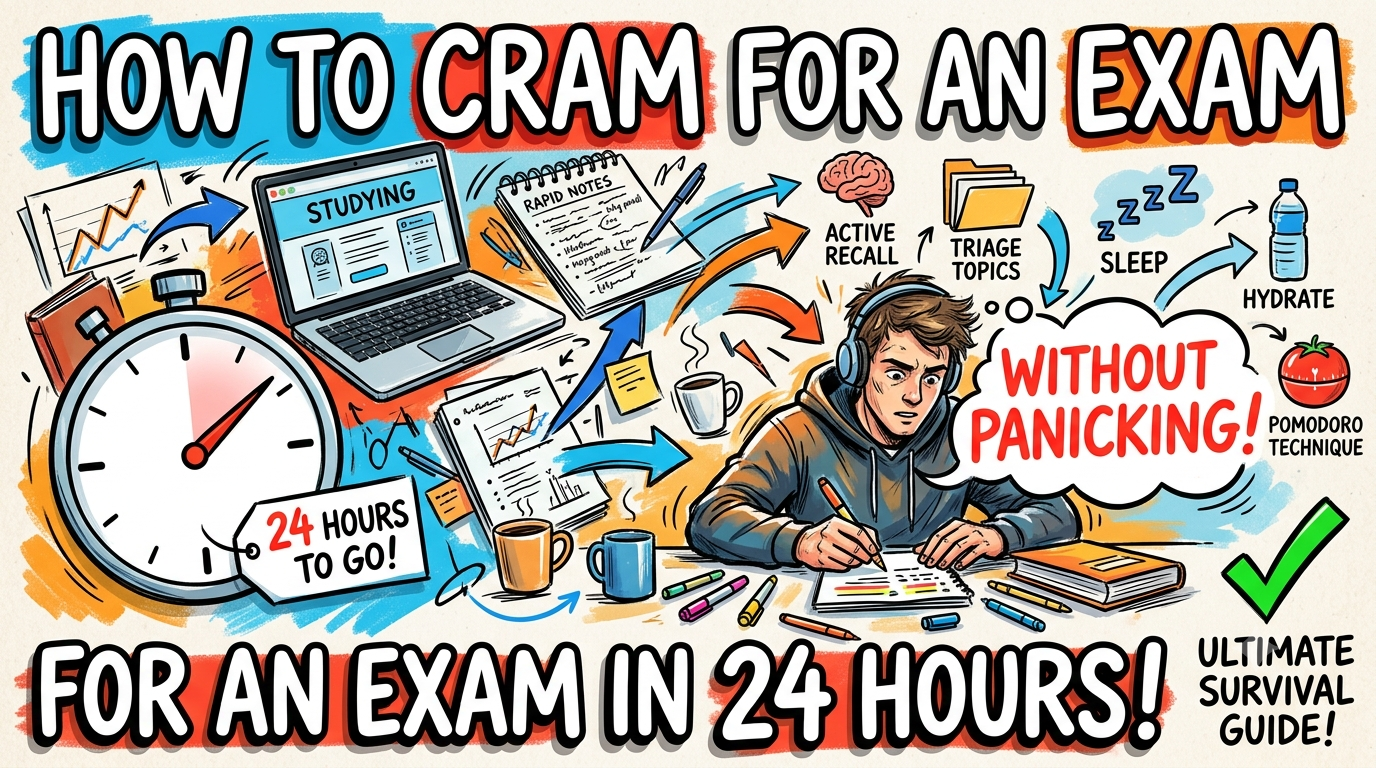
Exams can sneak up on anyone. Maybe you were busy with assignments, work, family responsibilities, or simply underestimated how much time you needed. Now, there’s only 24 hours left, and you’re wondering if it’s even possible to prepare.
The good news is that yes, you can make significant progress in one day. While last-minute studying isn’t ideal, using the right strategy can help you remember key concepts, improve your confidence, and perform much better than studying randomly.
This guide will show you exactly how to study effectively in the last 24 hours—without panicking.
First, Don’t Panic
The biggest mistake students make before an exam is wasting precious hours worrying.
Instead of thinking:
- “I’m going to fail.”
- “There’s too much to study.”
- “I should have started earlier.”
Tell yourself:
“I have 24 hours, and I’m going to use every hour wisely.”
A calm mind learns much faster than a stressed one.
Step 1: Know What Will Be on the Exam
Before opening your books, spend 15–20 minutes figuring out what matters most.
Ask yourself:
- What chapters are included?
- Which topics carry the most marks?
- Are there repeated questions from previous years?
- What concepts are most important?
If your teacher provided a syllabus or study guide, use it.
Don’t waste time studying topics that are unlikely to appear.
Step 2: Gather Everything You Need
Avoid getting distracted every few minutes.
Keep these items ready:
- Textbooks
- Class notes
- Previous year question papers
- Highlighters
- Water bottle
- Healthy snacks
- Calculator (if needed)
- Notebook for quick revision
Having everything in one place saves valuable time.
Step 3: Make a 24-Hour Study Plan
Don’t study randomly.
Break your day into focused sessions.
Example Schedule
Hour 1
- Plan your study.
- Identify important topics.
Hours 2–5
- Study the most difficult chapter.
Break (20 minutes)
Hours 6–8
- Study medium-level topics.
Lunch and short rest
Hours 9–12
- Solve previous year questions.
Evening
- Revise everything you’ve learned.
Night
- Review formulas, definitions, diagrams, and important points.
Before Sleeping
- Quick revision only.
Following a timetable keeps your mind organized.
Step 4: Focus on High-Weightage Topics
If you only have one day, don’t try to read every page.
Instead, focus on:
- Frequently asked questions
- Important definitions
- Formulas
- Diagrams
- Case studies
- Key concepts
- Long-answer questions
These usually contribute the most marks.
Step 5: Use Active Learning
Reading silently is one of the slowest ways to study.
Instead, try:
Teach Yourself
Explain each topic aloud as if you’re teaching someone else.
If you can’t explain it simply, study it again.
Write Short Notes
Instead of copying entire chapters, write:
- Keywords
- Important formulas
- Dates
- Definitions
Short notes are much easier to revise later.
Ask Questions
After finishing a topic, ask yourself:
- What is it?
- Why is it important?
- How does it work?
- Can I explain it without looking?
This improves memory much more than passive reading.
Step 6: Practice Previous Year Questions
Many exams repeat similar patterns.
Spend at least two to three hours solving:
- Previous year papers
- Sample papers
- Practice questions
- Mock tests
This helps you:
- Understand question patterns
- Improve speed
- Find weak areas
- Build confidence
Step 7: Use the Pomodoro Technique
Studying continuously for hours reduces concentration.
Instead, study like this:
- 50 minutes of focused study
- 10-minute break
Repeat the cycle.
During breaks:
- Stretch
- Drink water
- Walk around
Avoid scrolling social media.
Step 8: Eliminate Distractions
Your phone is probably your biggest enemy today.
For just one day:
- Turn on Focus Mode.
- Keep notifications off.
- Log out of social media.
- Keep your phone away while studying.
Every interruption makes it harder for your brain to refocus.
Step 9: Eat Brain-Friendly Foods
Your brain needs energy.
Choose foods like:
- Bananas
- Nuts
- Eggs
- Yogurt
- Fruits
- Whole grains
- Dark chocolate (in moderation)
Drink plenty of water.
Avoid:
- Heavy fast food
- Too many sweets
- Excessive caffeine
- Energy drinks
These can make you feel tired or anxious later.
Step 10: Don’t Skip Sleep
Many students believe staying awake all night helps.
Actually, sleep helps your brain store what you’ve learned.
Aim for 6–8 hours of sleep, even before an important exam.
A rested brain remembers much more than a tired one.
Quick Revision Tips
In the last few hours before the exam:
Revise:
- Formulas
- Important definitions
- Diagrams
- Tables
- Keywords
- Short notes
Don’t start learning completely new chapters at the last minute.
Exam Day Tips
Before entering the exam hall:
✔ Eat a light breakfast.
✔ Reach the exam center early.
✔ Carry all required materials.
✔ Take a few deep breaths.
✔ Read every question carefully.
✔ Answer easy questions first.
✔ Manage your time wisely.
✔ Leave a few minutes for revision.
Common Mistakes to Avoid
Many students lose marks because they:
- Panic before the exam.
- Try to study the entire syllabus.
- Ignore previous year papers.
- Spend hours on social media.
- Skip meals.
- Stay awake all night.
- Don’t revise.
- Waste time on unimportant topics.
Avoid these mistakes to maximize your score.
Can You Really Pass by Studying for Just 24 Hours?
The answer depends on several factors, including the difficulty of the exam, your prior knowledge, and how effectively you use your time.
If you’ve attended classes and have at least some understanding of the subject, a focused 24-hour study plan can help you review key concepts, strengthen weak areas, and improve your confidence. However, if you’re starting from scratch, one day may not be enough to master an entire syllabus. In that case, prioritize high-weightage topics and aim to secure as many marks as possible rather than trying to learn everything.
Remember, quality study is far more effective than simply spending long hours with your books open.
Final Thoughts
Cramming for an exam isn’t the best long-term study strategy, but when you have only 24 hours, a smart plan can make a big difference. Stay calm, focus on the most important topics, practice previous exam questions, revise actively, eat well, and get enough sleep.
The key isn’t to study everything—it’s to study the right things in the most effective way. With discipline and a positive mindset, you can walk into your exam feeling prepared and confident, even if time is limited. Good luck!